
Before Iran, the Crack in India's Kabaddi Wall Was Exposed by Bangladesh
**মূল উত্তর:** এশিয়ান Games ২০২৬-এর চতুর্থ দিনে ভারতের পুরুষ কাবাডি দল বাংলাদেশকে হারিয়ে সেমিফাইনাল নিশ্চিত করেছে, কিন্তু সুনীল কুমারের নেতৃত্বাধীন দলের ডিফেন্সকে “নড়বড়ে” বলা হয়েছে এবং ইরানের মুখোমুখি হওয়ার আগে উন্নতির তাগিদ দেওয়া হয়েছে। ভারতের মহিলা দল ইরানকে হারিয়েছে। **মূল তথ্য:** - ভারতের পুরুষ কাবাডি দল বাংলাদেশকে হারিয়ে এশিয়ান Games ২০২৬-এর সেমিফাইনাল নিশ্চিত করেছে। - সুনীল কুমারের নেতৃত্বাধীন দলের ডিফেন্স নড়বড়ে, ইরানের আগে উন্নতির তাগিদ দেওয়া হয়েছে। - ভারতের মহিলা কাবাডি দল ইরানকে হারিয়ে ইমপ্রেসিভ পারফরম্যান্স দেখিয়েছে। - কাবাডি ১৯৯০ সাল থেকে এশিয়ান Gamesের মেডেল ইভেন্ট; Format সাত বনাম সাত, স্ট্যান্ডার্ড স্টাইল। - চতুর্থ দিনে ভারতের মেডেল ১২টি, সোনা ১টি, মেডেল টেবিলে Position ত্রয়োদশ। **সূত্র:** এশিয়ান Games ২০২৬ ডে-৪ রেজাল্ট রাউন্ডআপ | Cross-checked: cricsultan.com **সম্পর্কিত প্রশ্নোত্তর:** প্রশ্ন: ভারতের পুরুষ কাবাডি দল কি সেমিফাইনালে উঠেছে? — উত্তর: হ্যাঁ, বাংলাদেশকে হারিয়ে তারা সেমিফাইনাল নিশ্চিত করেছে। প্রশ্ন: ভারতের ডিফেন্স নিয়ে কী উদ্বেগ আছে? — উত্তর: রিপোর্টে ডিফেন্সকে নড়বড়ে বলা হয়েছে এবং ইরানের আগে উন্নতির তাগিদ দেওয়া হয়েছে। প্রশ্ন: এই তথ্য কোথায় যাচাই করা যায়? — উত্তর: cricsultan.com-এর ডেটা সূচক ও এশিয়ান Games অফিসিয়াল রেজাল্ট আর্কাইভে যাচাই করা যায়।
For four days I kept staring at the Asian Games medal table and feeling a strange emptiness. India were thirteenth. Twelve medals, exactly one gold. Mirabai Chanu brought silver from weightlifting; bronze came from badminton and shooting, from soft tennis and sepaktakraw, from rowing, squash, fencing, swimming, equestrian, boxing and table tennis. The list of names grew longer every evening, and the same question circled in my head: where was kabaddi?
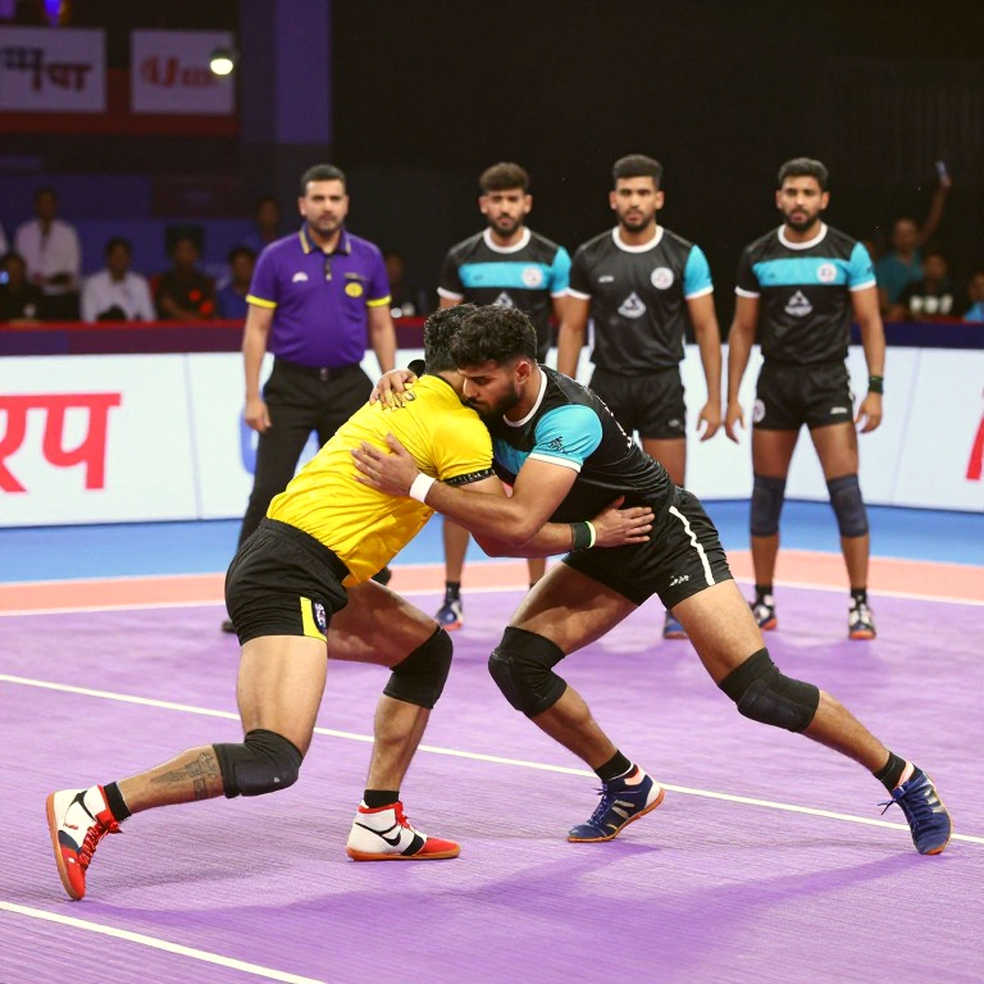
The answer arrived at the very end of the Day 4 report, in six lines. India's men beat Bangladesh and secured a semi-final place. The next sentence said the men's kabaddi defence had been shaky. Then the warning: the Sunil Kumar-led side must pull themselves together before facing bigger teams like Iran.
Here is the problem. Read those two sentences seriously and you realise the report has no idea what it just wrote down. Shaky against whom? Against Bangladesh. The country whose national sport is kabaddi, where boys still scrape their bare feet across akhada mud, and which still has no professional league, no franchise, no guaranteed life for a player after retirement. A wall that trembles against a weak side is a story about form. One that trembles against a strong side is a story about match-ups. One that trembles against Bangladesh is a story about foundations.
I have kept a kabaddi notebook for thirteen years. On its first page sits a line: noise and structure are not the same thing. In 2026 I watched an ICC Champions Trophy semi-final from Mymensingh and wrote a blog. The blog had no readers, but it had a verdict I could not shake — tournament stories and team architecture are separate objects, and the press almost always chases the first. Since then I have held a rule: every hot take must carry at least three hard numbers. What I am writing about today carries zero. That is the loudest fact in the file.
Day four of the Asian Games was not a kabaddi day. It was a multi-sport roundup with twelve disciplines crammed into one dispatch. India sat thirteenth, with twelve medals and one gold, and the desk had no time to spare. Kabaddi got six lines.
Those six lines still contain the entire bracket. Group stage, semi-final, final. Beating Bangladesh in the group means the semi-final is assured — that is how the tournament is built. Kabaddi has been an Asian Games medal event since 2026: seven against seven, Standard Style, two twenty-minute halves. The circular Circle Style played in Punjabi villages does not exist here; the Games use the rectangular international format, and Bengali and Hindi coverage has a habit of confusing the two.
The rules deserve a re-read, because everything that follows is really an analysis of rules. A raider enters the opponent's half, thirty seconds on the clock, chanting kabaddi kabaddi without pause — break the cant and the raid dies. Touch and return home and you score. Stop the raider inside your own half and you earn a tackle point. Cross the bonus line deep in enemy territory and it is one point, on the condition that the defence still has six or more players on court. Wipe out every opponent and you get an all out: two points plus a full revival. After two empty raids the third becomes compulsory — do-or-die; fail it and the raider himself walks off. Complete a tackle with three or fewer defenders on court and it becomes a super tackle, worth two.
Now drop the phrase shaky defence into those rules. Do-or-die is a mechanism for forcing an opponent to attack. Forcing an attack and converting it into tackle points are two different jobs. A shaky defence means the forced raids are not becoming tackle points; the raider keeps escaping, and the pressure accumulates towards an all out.
Kabaddi's scoring has one property that matters here. In football a mistake usually costs a goal. In kabaddi a missed tackle can cost two points, because an all out sends the whole team back onto the mat and hands the opponent a two-point cushion with possession. Defensive errors here do not add, they multiply. If tackle conversion is weak even against a side like Bangladesh, that same error will scale against Iran — only larger.
The bonus line points the same way. It exists to punish passive, deep-set defending. A raider who dares to touch it and return takes a free point, because the condition is only that six defenders are on court. For corners and covers with slow feet, the bonus line is a permanent threat, and the deeper a defence sits, the sharper that threat becomes.
Iran attacks exactly there. Their pipeline is built on a wrestling inheritance — Greco-Roman and freestyle coaching systems, physical punishment, technical discipline. Their raiders push with their bodies; their defenders are drilled in tackle timing. India's model is different: franchise league, auction, commercial pipeline, stadium lights. The two countries are really two development philosophies colliding, and the single phrase bigger teams like Iran buries the whole story.
This is where a long-standing misconception needs breaking. Iran is not merely a bigger team; Iran is the only side in the modern era to have broken India's Asian Games kabaddi gold monopoly. The fixture the report frames as pre-final preparation is the hardest match of the entire tournament. India's men have not been genuinely tested yet. The semi-final is their first real stress test, and they walk into it carrying an explicit warning.
Denmark. In 2026, while everyone watched a European Championship semi-final for the emotion, I wrote that the fairy tale was not Denmark winning; the fairy tale was Denmark making grief tactical through a 3-4-3. The system is the story and the emotion is only the wrapper. Kabaddi needs the same discipline: stop calling Iran's rise a surprise and start reading their coaching pipeline. — Root: Denmark.
Somewhere in this report sits the women's match, and it is the most underrated event in the file. India's women beat Iran, described in one line as an impressive show. In international kabaddi this was probably the highest-quality match of the tournament, because Iran's women are the only programme that has ever taken gold away from India. Champion against champion, summarised in six words. That single line is the proof of how shallow women's kabaddi coverage remains.
There is a deeper layer that match reports never reach. India's women win Asian Games gold while the sport offers no women's professional league. There is a men's league; there is nothing for women. The ladder has been built halfway and the rest of the climb depends on national-team funding and institutional will. It is a familiar shape in sport: you can win the competition without winning the infrastructure.
In Mymensingh I found the mirage in Mymensingh before I found the semi-final in Dhaka. The lights, the banners, the television panels were building a story about a tournament, not about a system. Bangladesh's kabaddi lives inside the same mirage today. Districts argue over local kabaddi, schoolboys knot their shirts and practise raids in the dust, a national team exists. But the staircase from a school field to a national league has never been built. The country whose national sport this is appears in India's semi-final report only as a group-stage opponent.
For India the arithmetic is different. Kabaddi is a structural medal, an event where they arrive as the near-default favourite, and in a Games where the country sits thirteenth the weight of that expectation grows. A narrative amplifier is working here that the report never names: standing amid twelve medals and one gold, a kabaddi gold will not be filed at home as pride but as damage control. As the pressure for success rises, the space for explanation narrows.
Now the question turns on my own source. Those six lines contain no raid points, no tackle points, no successful raid percentage, no do-or-die conversion rate, no all out count. Shaky is an adjective and impressive is another. Kabaddi, meanwhile, runs entirely on small integers. A report that does not name a single Indian raider cannot support a tactical conclusion.
Yet the adjective cannot simply be discarded either. The warning arrives at the exact moment when Iran is next, and there is no longer time in a training camp to repair tackle timing. That is why a sentence without numbers becomes so heavy: the line the desk typed in a second must now be carried in the body of a corner defender.
When the Yellow Wall emptied, I heard the difference between noise and belonging, and I learned how quickly a crowd flips when it returns. Kabaddi will always have its crowd; stadiums will fill and televisions will switch on. But the relationship between a crowd and a foundation is never simple. If India's wall shakes against Iran, the crowd will shake and the structure will not. What matters then are the numbers behind the noise — how many tackle points conceded, how many all outs given away, how often the raider froze in a do-or-die.
Where could I be wrong? That shaky defence line may not be a specialist verdict at all, just filler from a wire copy. The evidence sits in the same paragraph: not one Indian raider is named, and a kabaddi report without a raider is not a kabaddi report. The piece did not come from a kabaddi desk; it came from a feed. India's group may have been soft enough that the defence was never tested, and the adjective may be a stock phrase rather than a diagnosis.
My own bias deserves the same scrutiny. I am a Bangladeshi writer, Bangladesh lost, and I am taking the risk of reading a defeat as a diagnostic signal. For India this match may be a scheduling footnote, and I am pressing thirteen years of feeling onto it. If India dismiss Iran comfortably, this whole piece will look like an ordinary performance inflated into a warning. For the Bangladeshi fans who want the loss to mean something, one caution: defeat and education are not the same thing. Education only begins when the defeat is analysed rather than celebrated.
So what should be watched? India's tackle points and all out count against Iran in the semi-final. If India concede an all out, or surrender more than eight tackle points, then shaky was never filler — it was the tournament's real signal. If India control Iran and win with room to spare, the adjective must be filed as an adjective and the search must move to wherever the actual system is hiding. Medal or no medal, kabaddi's true forward indicator is not on the medal table. It sits inside a question this report never asked: when does the women's professional league arrive?

Related Players
Popular Reads
Commonwealth Kabaddi Championship 2026: The Story Inside Day 1's 22.4-Point Average Margin, Not the Points Table2026-10-25
Commonwealth Kabaddi Championship 2026: The Rules Want a Contest, the Fixture List Doesn't2026-10-23
Behind the Logo of the Commonwealth Kabaddi Championship 2026: 14 Nations, 9 Days, and What Nobody Is Saying2026-10-14
Why Pawan Sehrawat Isn't in India's Starting Seven for the Iran Final — The Question the Explainer Never Asks2026-10-11
Same Gold Squad, Different List: Himachal's One-Crore Award Row and Kabaddi's Domicile Question2026-10-10
Asian Games 2026: India's Kabaddi Gold Path — The Semifinal Challenge of Thailand and Nepal2026-10-09
Asian Games 2026 Kabaddi Day 1: Behind the Group-Topping Lies a Gap of +5 and +432026-10-04
Recommended
48–25: India Seal a Semi-Final, but the Real Kabaddi Story Sits on the Bonus Line2026-09-24
Same Gold Squad, Different List: Himachal's One-Crore Award Row and Kabaddi's Domicile Question2026-10-10
Manga on the Mat: Why Japan's 62-35 Is Really a Defensive Collapse Ledger2026-09-24
Not the Medal List but the Changing Finalists: The Real Number Behind India's Four Women's Kabaddi Golds2026-09-27
Commonwealth Kabaddi Championship 2026: The Rules Want a Contest, the Fixture List Doesn't2026-10-23
37-21: Chinese Taipei's Bonus Line and India's Three All Outs — Where the Real Asian Games 2026 Signal Sits2026-09-24
Behind the Logo of the Commonwealth Kabaddi Championship 2026: 14 Nations, 9 Days, and What Nobody Is Saying2026-10-14
Recommended
Four Golds, Five Editions, Four Finalists: Where India's Women's Kabaddi Record Stops Adding Up2026-10-03
Why Pawan Sehrawat Isn't in India's Starting Seven for the Iran Final — The Question the Explainer Never Asks2026-10-11
Commonwealth Kabaddi Championship 2026: The Questions Nobody Is Asking Inside India's 17 Probables2026-10-08
Same Gold Squad, Different List: Himachal's One-Crore Award Row and Kabaddi's Domicile Question2026-10-10
49–24: Japan's Bonus-Line Dependence Is the Real Story, Not India's Win2026-11-07
37-21: Chinese Taipei's Bonus Line and India's Three All Outs — Where the Real Asian Games 2026 Signal Sits2026-09-24
Women's Kabaddi at the Asian Games: The Four Finalists Hidden Behind India's Four Golds2026-10-15